Predictive Frontline Optimisation
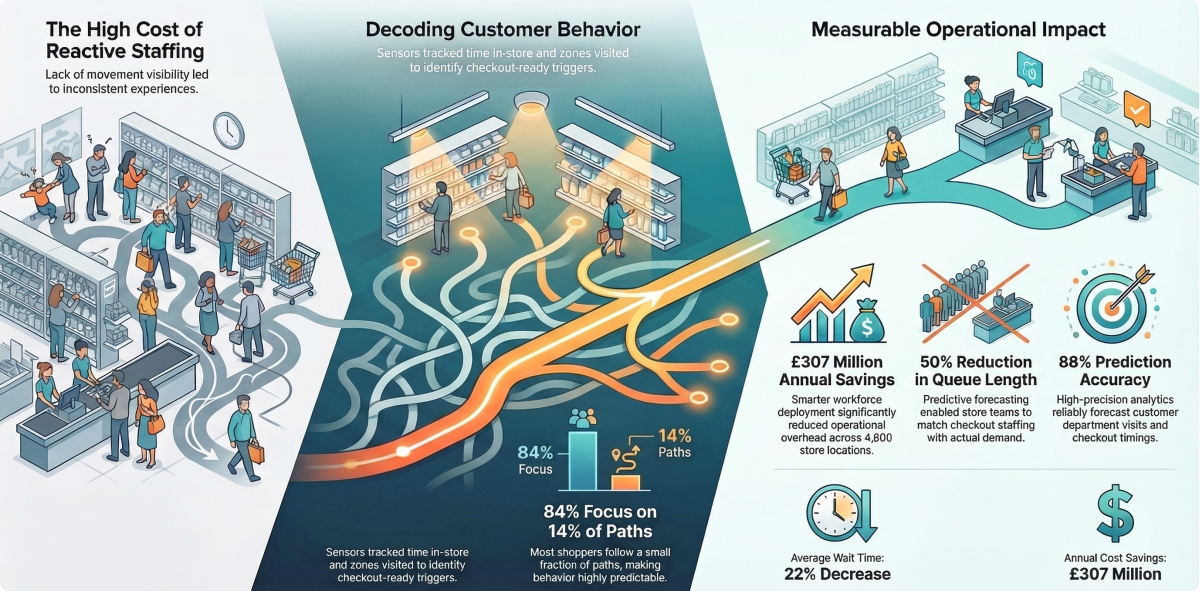
The client faced a critical disconnect between staffing levels and actual customer demand patterns. Traditional scheduling based on historical sales volume failed to account for real-time browsing behavior, leading to congested checkout lanes during peak windows and idle personnel during lulls. The objective was to move beyond reactive management toward a data-driven, predictive model of store operations.
We implemented an end-to-end analytical framework utilizing tracking sensors and computer vision to map granular customer movement. By applying a hybrid methodology—combining CHAID (Chi-squared Automatic Interaction Detection) for customer segmentation, multi-variate regression for trend analysis, and SVM (Support Vector Machines) for pattern recognition—we identified the leading indicators of transaction spikes before they hit the point of sale.
“84% of shopping activity followed just 14% of paths”
The integration of predictive frontline optimisation resulted in a monumental shift in operational efficiency. By aligning staff allocation with real-time customer flow, the client realised a cost saving of £307 million annually.
Key performance indicators showed a 50% reduction in queue length and a 22% decrease in wait time, directly correlating to a double-digit increase in customer satisfaction scores. Most notably, the model achieved an 88% prediction accuracy for demand fluctuations up to 4 hours in advance.